
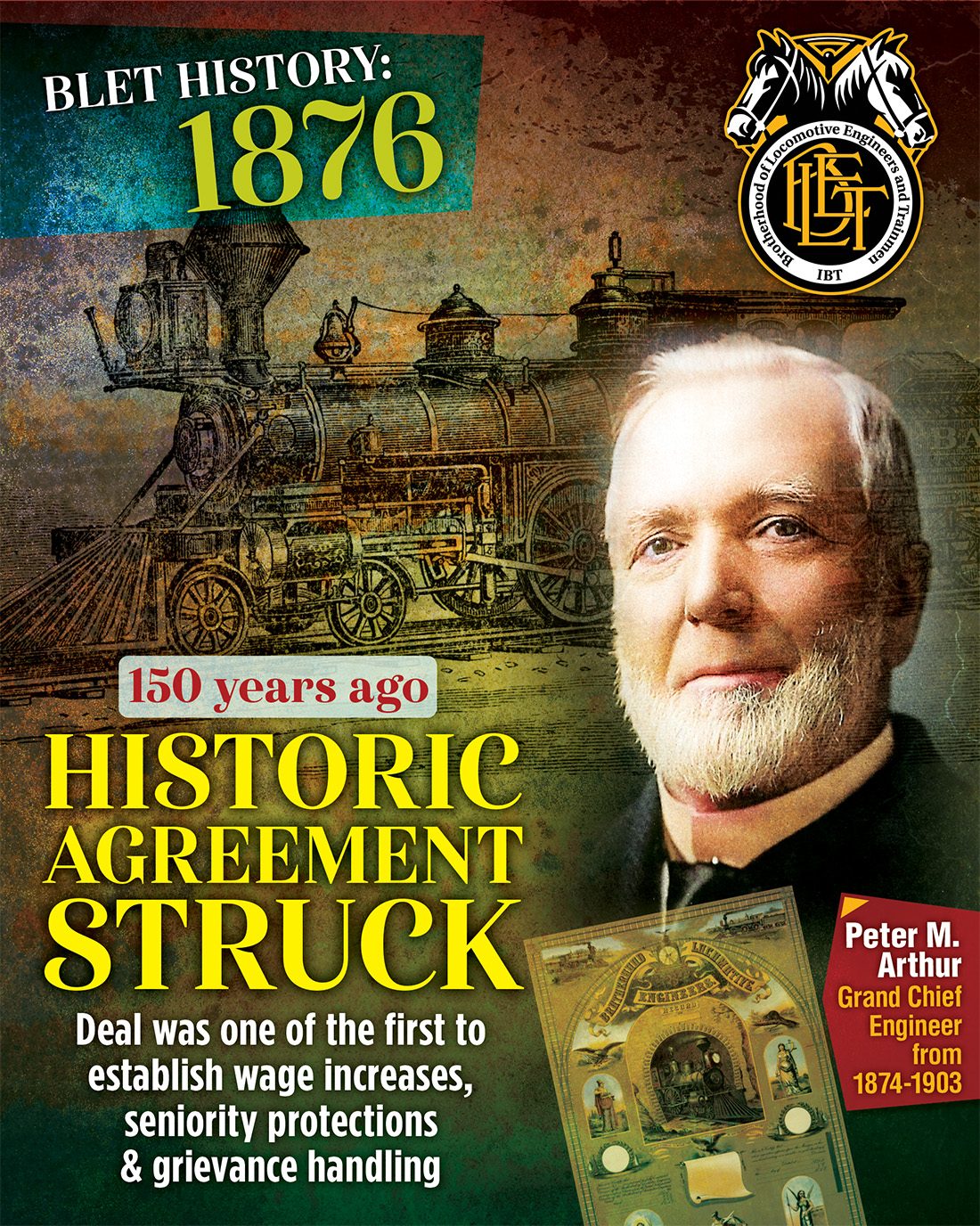
In the year 1876, numerous grievances by early members of the Brotherhood of Locomotive Engineers nearly led to a strike at the Central Railroad of New Jersey Central.
After intervention by Grand Chief Engineer Peter M. Arthur, the engineers and the railroad came to an agreement that established provisions governing wage increases, seniority protections, and grievance handling — important building blocks that serve as the basis for many Brotherhood contracts in effect today. The BLET was founded on May 8, 1863, and this represents one of the earliest recorded agreements in the union’s history.
The agreement, which was signed by railroad President E.C. Knight, reads in part:
“On and after October 1, 1876, the rate of wages for all engineers who have been in the service of the company for a term of two years, shall receive ninety dollars ($90) per month for 2,600 miles or less.”
“The oldest engineers in the service of the Company to have the preference of engines and trains when competent and worthy, and in case of a surplus, the oldest in service to have the preference of work.”
“To avoid any further trouble on the Central Railroad of New Jersey, between the company and its engineers, or that any engineer be discharged… the proper officials shall receive a committee of engineers, and arbitrate all difficulties.”
The railroad president accepted the terms of the agreement while the BLE was in the midst of its 13th Annual Convention in Detroit. When Grand Chief Arthur informed the delegates of the agreement, which represented a complete victory for the union in its conflict with the Central Railroad of New Jersey, his announcement was met with loud applause by the entire convention.